
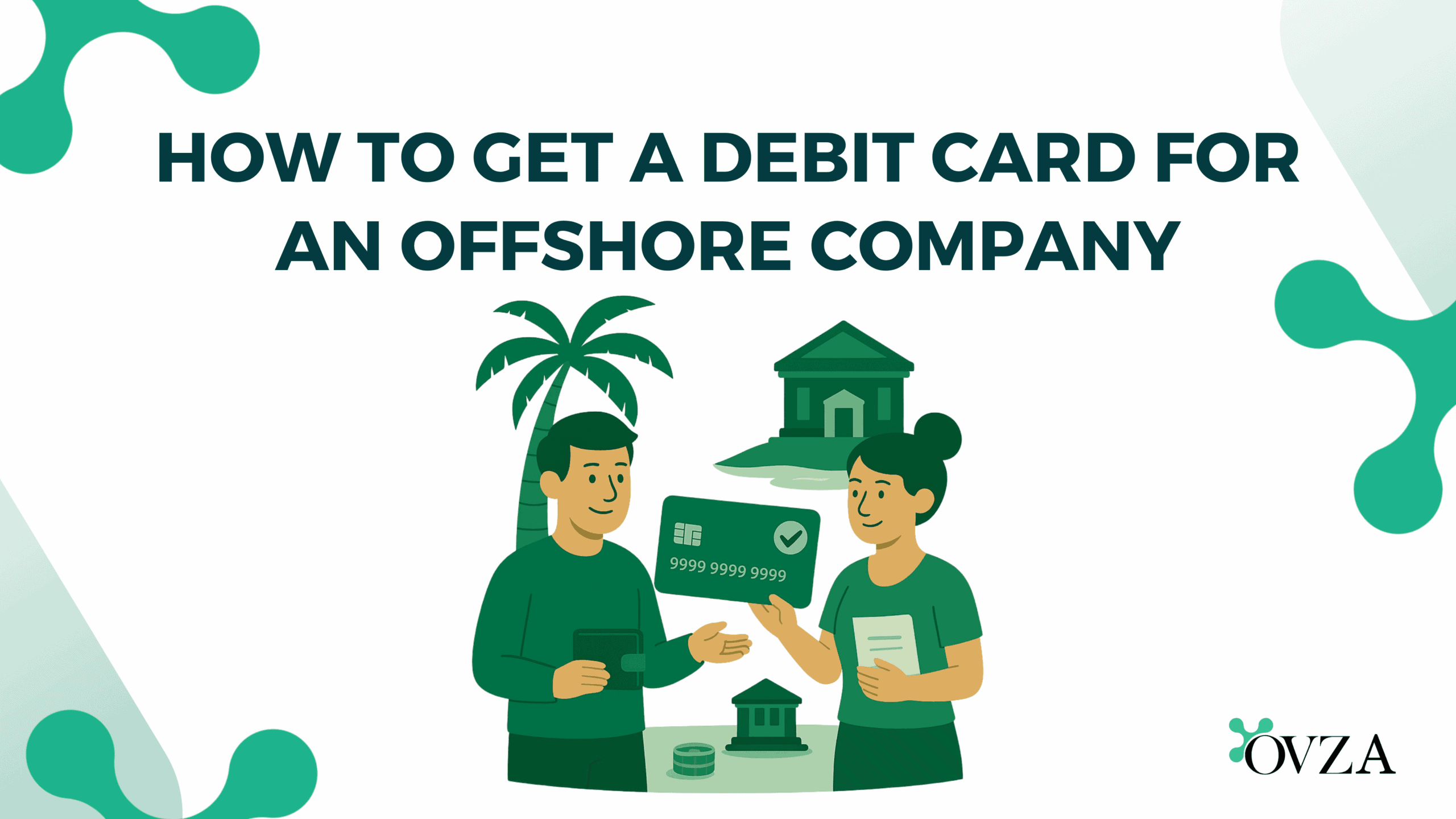
Yes, it is definitely possible for an offshore company to access physical and virtual debit cards, provided it works with a bank or EMI that supports non-resident entities.
Debit Card for an Offshore Company entities incorporated in jurisdictions such as the British Virgin Islands, Seychelles, Belize, Mauritius, and the Cayman Islands regularly receive debit cards linked to multi-currency corporate accounts. The central question is not whether offshore companies can get debit cards, but rather which types of institutions are equipped to onboard non-resident corporate structures without regulatory friction.
In modern financial regulation, the eligibility of an offshore trading company for debit card issuance is determined by the institution’s onboarding framework, not the company’s jurisdiction of incorporation. Research published by the OECD on non-resident corporate access confirms that offshore companies are treated the same as domestic entities when applying for corporate debit cards, provided they meet standard KYC, AML, and source-of-funds requirements. The legal architecture does not prohibit offshore debit cards; instead, it emphasizes transparency, lawful activity, and proper institutional risk classification.
How Banking Rules Treat Offshore Companies
Offshore banking is a specialized niche, and it operates under a very different set of assumptions than standard domestic banking. Contrary to common misconceptions, offshore banking is not inherently “high risk,” nor are offshore companies presumed to be suspicious entities. The risk classification depends entirely on the business activity of the offshore company itself, the transparency of its ownership, and the quality of its documentation. A well-structured offshore trading company engaged in lawful cross-border commerce is treated no differently than any other non-resident commercial entity under international banking standards.
However, difficulties arise when an offshore company approaches the wrong type of bank—typically a domestic retail bank that is not structurally prepared or licensed to handle non-resident or cross-border corporate accounts. These institutions are designed for local clients, domestic economic activity, and predictable transaction patterns. When an offshore company attempts to onboard with such a bank, even if the bank mistakenly approves the application or is misled by incomplete information, the offshore company quickly becomes a compliance nightmare. The account may be subjected to recurrent document requests, unexplained freezes, transaction challenges, or abrupt closure due to internal policy conflicts rather than legal violations.
Why Offshore-Friendly Institutions Treat Offshore Companies Properly
International EMIs and multi-currency institutions, by contrast, are structured precisely for non-resident entities and offshore trading activity. Their compliance frameworks are designed to analyze foreign corporate structures, cross-border payments, and multi-jurisdictional ownership. This is why they routinely issue corporate debit cards to offshore companies, provided standard KYC and AML checks are satisfied.
Research by the OECD on non-resident corporate access confirms that offshore companies are eligible for debit card issuance when their business activity is transparent, lawful, and economically coherent.
Global regulatory bodies such as the Financial Action Task Force (FATF) emphasize that the decisive factor is not where the company is incorporated, but whether the institution understands the client’s operating model. Offshore-capable banks and EMIs classify offshore companies accurately, based on their real activity, not based on stereotypes or outdated assumptions. This is why most problems arise only when an offshore company attempts to operate in a banking environment that is structurally incompatible with offshore commerce.
Physical Debit Cards for Offshore Companies
One of the most common forms of offshore corporate debit access is the UnionPay physical debit card. UnionPay issuers are historically more open to non-resident corporate structures, and the card network itself is designed for international merchants and traders operating across Asia, Africa, and parts of Europe. Offshore companies incorporated in BVI, Seychelles, Belize, and similar jurisdictions are frequently issued UnionPay cards because the underwriting process focuses on the legitimacy of the company’s business activity rather than its geographical origin.
These physical cards function globally, allow ATM withdrawals, and are typically tied to multi-currency corporate accounts held at offshore-friendly EMIs or international banks.
The issuance of a UnionPay physical card is therefore not unusual or difficult for an offshore trading company. It is a standard commercial tool used by companies that buy and sell goods across borders and require a secure, internationally accepted payment instrument for operational expenses, freight costs, travel, supplier payments, and corporate disbursements.
Virtual Debit Cards for Offshore Companies
While UnionPay dominates the physical card segment for offshore entities, most offshore companies receive their Mastercard or Visa debit cards in virtual form. Virtual debit cards are widely used in offshore banking because they do not require cross-border logistical delivery, and they fit with remote KYC onboarding models. EMIs specialized in non-resident accounts, such as those operating in the EU, UK, and certain APAC jurisdictions, issue Mastercard and Visa virtual cards that can be added directly to Apple Pay, Google Pay, and other digital wallets.
For offshore companies engaged in e-commerce, consultancy invoicing, online procurement, or global digital operations, virtual cards are often more practical than physical cards. They can be generated instantly, replaced easily, and used for international transactions without the delivery restrictions associated with physical cards.
The virtual nature of these cards aligns with the regulatory frameworks described by the OECD, which recognize that non-resident entities require flexible payment tools that match the geographic spread of their commercial activity.
Why Offshore Banking Is Not Inherently High Risk
A common misconception is that offshore banking is high risk. In reality, the risk classification depends entirely on the business activity of the offshore company. An offshore company engaged in lawful export–import, consulting, logistics, wholesale distribution, software development, or digital commerce is generally categorized as low to moderate risk, provided it demonstrates transparent ownership and source of funds.
What regulators consider “high risk” is not the offshore structure itself, but opaque business models, cash-intensive transactions, or industries historically associated with regulatory scrutiny. Offshore companies operating in mainstream commercial activities are treated as fully legitimate non-resident corporate clients under FATF guidelines.
Thus, the offshore element is not the risk factor. The activity is.
Why Choosing the Wrong Bank Creates Compliance Nightmares
The real problem arises when an offshore company attempts to open an account at a bank that is not structured to handle offshore or non-resident clients. Domestic retail banks often lack:
- cross-border compliance teams
- multi-jurisdictional risk evaluation models
- non-resident KYC infrastructure
- support for foreign corporate documents
When an offshore company mistakenly opens an account at such a bank, whether due to an uninformed application, a sales representative misunderstanding, or incomplete disclosure, the onboarding may succeed by accident, but the relationship inevitably collapses.
Within weeks or months, the offshore company may face:
- repeated requests for “updated documents”
- unexplained transfer blocks
- inquiries about foreign counterparties
- account freezes
- sudden and irreversible closure
This is not caused by wrongdoing.
It is caused by using the wrong institution.
The bank’s internal policies simply do not permit long-term servicing of non-resident, foreign-owned corporate structures. The offshore company becomes a compliance exception, something the institution was never designed to support.
Why Offshore-Friendly Institutions Avoid These Problems
Offshore-capable banks and EMIs prevent these issues because their operational model is built around non-resident businesses. Their risk teams are trained to evaluate source-of-funds from multiple countries, understand offshore company registries, process cross-border payments, and issue both physical and virtual debit cards to foreign clients.
They know what an offshore company is.
They know how it operates.
And they know how to classify it correctly.
This is why working with the right offshore-friendly institution is the difference between:
a functional offshore corporate banking setup
and
a compliance disaster waiting to happen.
Conclusion
Offshore companies can unquestionably obtain both physical and virtual debit cards, and the process is far more standardized than most clients assume. The decisive factor is not the offshore nature of the entity, but whether the company works with institutions specifically designed for non-resident corporate banking. Offshore-capable banks and EMIs operate within regulatory frameworks built for cross-border commerce, which is why they regularly issue UnionPay physical cards and Mastercard or Visa virtual cards to offshore trading companies, consultancy firms, holding structures, and global procurement entities.
The challenges associated with offshore banking do not arise from regulatory prohibition, but from choosing institutions that are structurally incompatible with offshore or non-resident corporate clients. Domestic retail banks, which are designed exclusively for local businesses, often misclassify offshore entities and create unnecessary compliance strain. Offshore-friendly institutions, in contrast, accurately evaluate the business activity, documentation, and commercial purpose of the company, making debit card issuance smooth, compliant, and aligned with international best practices.
For international operators, the takeaway is clear. The offshore company remains a legitimate and efficient vehicle for global commerce, and access to debit cards, virtual or physical, is readily available when managed through the correct banking channels.
Disclaimer: The information provided on this website is intended for general reference and educational purposes only. While OVZA makes every effort to ensure accuracy and timeliness, the content should not be considered legal, financial, or tax advice.