
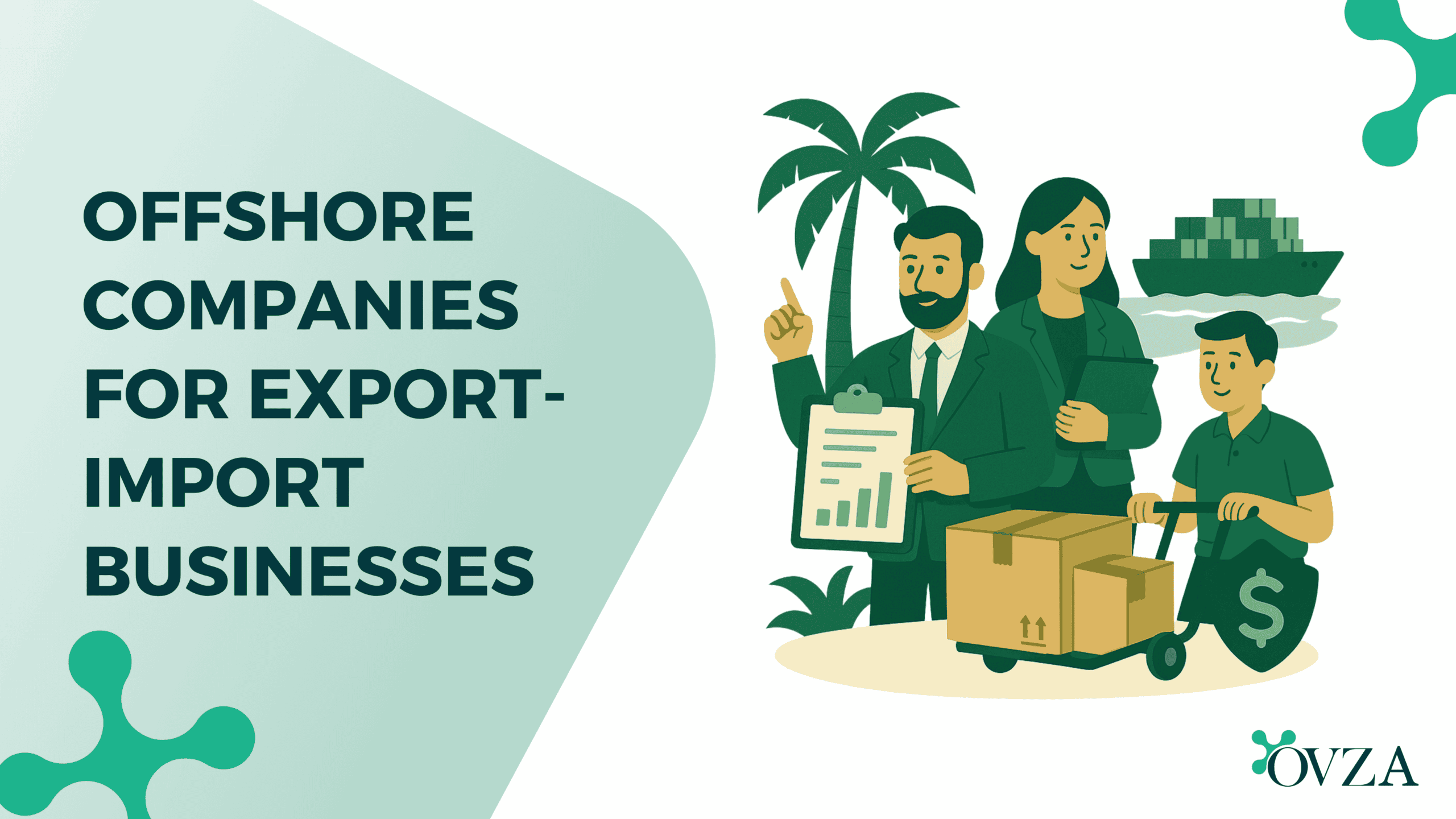
Offshore Companies for Export Import offer legal advantages for export–import businesses that domestic structures cannot provide.
In cross-border trade, the rules that apply to a transaction frequently arise not from the movement of goods, but from the jurisdiction where the company is incorporated. This creates a situation in which a domestic entity becomes subject to import licensing, VAT or GST exposure, currency regulation, and banking scrutiny, even when the trade occurs entirely outside its home territory. In this context, using an offshore company for export import operations ensures the transaction is recognized as foreign to foreign commerce. The International Chamber of Commerce (ICC) has noted that these obligations often stem from “the corporate nationality of the entity rather than any substantive connection to the transaction” (ICC Trade Regulations Commentary, 2021).
Offshore jurisdictions respond to this problem by creating corporate forms designed for international commerce. Their legislation explicitly separates the company’s legal existence from domestic trade obligations, allowing it to operate as a neutral participant in foreign to foreign transactions. This is one of the principal offshore company advantages that supports global procurement. The OECD’s 2019 analysis of cross-border trading entities confirms that this structural separation reduces the artificial compliance burdens that domestic companies inherit simply because of their place of incorporation. For this reason, many businesses adopt an offshore trading company structure as part of their international trading company setup.
The Regulatory Burden on Domestic Trading Entities
Domestic trading entities often encounter regulatory obligations that are disproportionate to the nature of their international activities, and this is precisely where offshore companies provide significant legal and operational advantages. When a company incorporated in Country A engages in a foreign to foreign transaction, purchasing goods in Country B for resale in Country C, the domestic entity may still become entangled in compliance frameworks that were never intended for offshore trading activities. This phenomenon has been highlighted by institutions such as the International Chamber of Commerce (ICC), which observes that many regulatory burdens arise simply because the company is domiciled in that jurisdiction, not because the trade itself bears any territorial connection to the domestic economy (ICC Trade Regulations Commentary, 2021). This is why many operators question offshore company vs domestic company for trading, and increasingly prefer offshore structures when conducting global procurement and resale.
From a structural perspective, domestic incorporation creates a legal nexus that automatically subjects the company to local import licensing statutes, currency control measures, VAT expectations, and heightened banking oversight. These rules are territorially designed, yet domestic entities inherit them even when the goods never enter the country. The OECD’s 2019 analysis of cross-border trading entities confirms that domestic companies conducting offshore transactions are often pulled into compliance frameworks “misaligned with the actual geography of the commercial activity.”
This is precisely why offshore companies provide a superior solution. Offshore jurisdictions intentionally legislate corporate vehicles whose legal personality does not trigger domestic trade rules when conducting business abroad. Instead of being treated as domestic traders, offshore companies are recognized as non-resident commercial actors whose activities fall under the jurisdiction of their offshore incorporation. This is a core legal benefit of offshore companies in international trade, as it enables businesses to structure their operations through a legally coherent offshore company for international trade rather than through a domestic entity.
This removes the artificial regulatory nexus that domestic companies are forced to carry, and aligns the legal identity of the contracting party with the true territorial nature of the trade. Academic commentary from the Centre for Trade and Economic Integration (CTEI) supports this structural solution, noting that offshore entities eliminate the “jurisdictional overreach” that domestic corporations face when engaging in international supply chains (CTEI Working Paper No. 17, 2020). In other words, the offshore company is not an avoidance tool, it is the legally correct contracting vehicle for transactions that occur entirely outside the domestic market.
This pro-offshore legal reality is consistent across major international trading hubs. The offshore company is able to transact cleanly in cross-border environments precisely because it is not burdened by domestic rules designed for internal commerce. This is the primary reason global exporters, procurement firms, freight consolidators, and commodity trading houses structure their operations through offshore companies rather than through their domestic entities. These companies recognize that an export import offshore company offers clarity, neutrality, and regulatory efficiency unmatched by domestic structures.
Using an Offshore Company in Place of a Domestic Entity
For many export–import operators, the decision to conduct trading activity through an offshore company rather than a domestic company is not motivated by simplicity alone, but by structural and legal concerns inherent in global commerce. In numerous jurisdictions, the domestic company creates an unintended legal nexus that links the transaction to domestic regulators, banks, and tax authorities even when the goods and counter-parties are entirely foreign. This is why offshore companies frequently serve as the designated commercial entity for procurement, resale, freight coordination, and payment settlement. In practice, businesses choose an offshore company for export import operations precisely because it functions as a non-resident trading actor.
The International Chamber of Commerce (ICC) has acknowledged this practice as a legitimate structural approach, noting that non-resident entities “may reduce regulatory distortions created by domestic incorporation” in cross-border trading chains (ICC Trade Regulations Commentary, 2021). The following business use cases illustrate how this works in practice and why the offshore trading company has become a central tool for cross-border commerce.
1. When the Domestic Entity Creates Regulatory Exposure that the Offshore Company Avoids
Many domestic legal systems impose trade-related requirements simply because the domestic company is listed as the buyer or seller. Even without physical importation, the domestic company may become subject to local import licensing rules, VAT registration expectations, and foreign-exchange monitoring. The OECD’s research on cross-border trading entities confirms that domestic incorporation alone can generate “superfluous compliance obligations” unrelated to the actual movement of goods (OECD, Cross-Border Trade Report, 2019). This is why using an offshore company structure for cross-border trade is often the more appropriate legal configuration.
An offshore company eliminates this exposure by acting as a non-resident trading party. Because it is not considered a domestic operator, the transaction is not brought under domestic licensing statutes or domestic customs rules, which are territorially limited. This use case is especially relevant for businesses headquartered in jurisdictions with strict currency laws, heavy regulatory oversight, or complex import regimes.
2. When Supplier or Customer Confidence Is Impacted by the Domestic Jurisdiction
Export–import companies often discover that their domestic jurisdiction carries geopolitical or compliance-related risk in the eyes of suppliers or buyers. Banks in certain regions may classify domestic entities as higher risk, freight forwarders may require additional documentation, and overseas suppliers may hesitate to transact due to perceived instability or policy rigidity. In these cases, the offshore entity for procurement and resale provides confidence and neutrality.
An offshore company incorporated in a neutral, commerce-oriented jurisdiction often mitigates these concerns. Jurisdictions such as the British Virgin Islands, Seychelles, or the Cook Islands are widely recognized in global trade documentation systems and international banking networks. As a result, the offshore company may function as a more acceptable contracting party than the domestic counterpart. The Better Business Bureau’s 2023 advisory on international merchant structuring noted that neutral offshore jurisdictions often reduce onboarding friction because they align more closely with established international transaction patterns.
This use case is especially significant for companies operating in emerging markets where domestic institutions face higher scrutiny. It demonstrates why many traders ask why use an offshore company for export import, and ultimately adopt offshore structures as their primary commercial vehicle.
3. When Banking Efficiency Requires a Non-Domestic Entity
Banks in the domestic jurisdiction may not accommodate the company’s transaction profile, especially if the company regularly sends payments to multiple countries, receives funds in different currencies, or operates in industries with thin margins and rapid settlement cycles. Domestic compliance teams often interpret these flows as inconsistent with typical domestic business models, leading to delays, enhanced due diligence, or unexpected account restrictions.
Offshore companies can, in many cases, access more suitable financial institutions and electronic money operators (EMIs) that specialize in multi-currency cross-border flows. These institutions are accustomed to foreign to foreign trade and do not view the transaction pattern as anomalous. Offshore corporate legislation is specifically designed to support banking relationships where the operational footprint is international rather than domestic.
4. When Domestic Tax Interpretation Could Attach to Foreign-to-Foreign Transactions
In some jurisdictions, domestic tax authorities apply domestic tax laws based on corporate domicile rather than territorial source. This can lead to an interpretation, sometimes incorrectly, that offshore to offshore transactions carried out by the domestic company may fall within the domestic tax net.
CTEI has examined this phenomenon and concluded that domestic tax residence alone can create a “misplaced presumption of territorial nexus” (CTEI Working Paper No. 17, 2020). By using an offshore company that is legally non-resident, the business aligns the legal contracting party with the true territorial nature of the transaction, avoiding interpretive overreach by domestic tax authorities. This reinforces the need for an offshore company for global commerce, especially in industries with large-volume, low-margin transactions such as commodities trading, wholesale distribution, or freight consolidation.
5. When Operational Neutrality Is Required for Multi-Country Deals
Complex supply chains often involve suppliers, buyers, logistics operators, and banks located across different regulatory environments. When the domestic company acts as the contracting party, each foreign counterparty may attempt to determine whether the domestic country’s regulations apply, creating prolonged compliance reviews.
The offshore company provides operational neutrality. It sits outside the domestic regulatory framework and is recognized internationally as a non-resident commercial entity. In transactions involving multiple jurisdictions, especially between countries with political or economic tensions, a neutral offshore company acts as an acceptable middle ground that avoids sensitive cross-border legal entanglements.
Academic commentary from the World Trade Institute has emphasized the importance of “jurisdictional neutrality” in multi-regional supply chains as a mechanism for reducing trade friction and ensuring predictability (WTI Trade Governance Review, 2020).
Conclusion
Offshore companies provide a legally coherent structure for export–import businesses whose transactions occur outside their domestic market. Domestic incorporation often creates an artificial regulatory nexus, triggering tax, licensing, and banking obligations that have no connection to the actual movement of goods. Offshore jurisdictions were designed to correct this mismatch by offering corporate forms that operate as non-resident commercial actors in cross-border supply chains.
Institutions such as the ICC, OECD, and CTEI have recognized that offshore entities enhance predictability, reduce regulatory friction, and provide neutrality in multi-jurisdictional trade. This neutrality translates into smoother banking relationships, clearer contracting, and greater confidence from suppliers and buyers alike. For companies engaged in global procurement and resale, offshore incorporation is not simply an alternative, it is often the most appropriate legal and operational framework.
By aligning the corporate identity with the territorial reality of the transaction, offshore structures allow international trade to function as intended, efficiently, transparently, and without unnecessary domestic interference.
Disclaimer: The information provided on this website is intended for general reference and educational purposes only. While OVZA makes every effort to ensure accuracy and timeliness, the content should not be considered legal, financial, or tax advice.